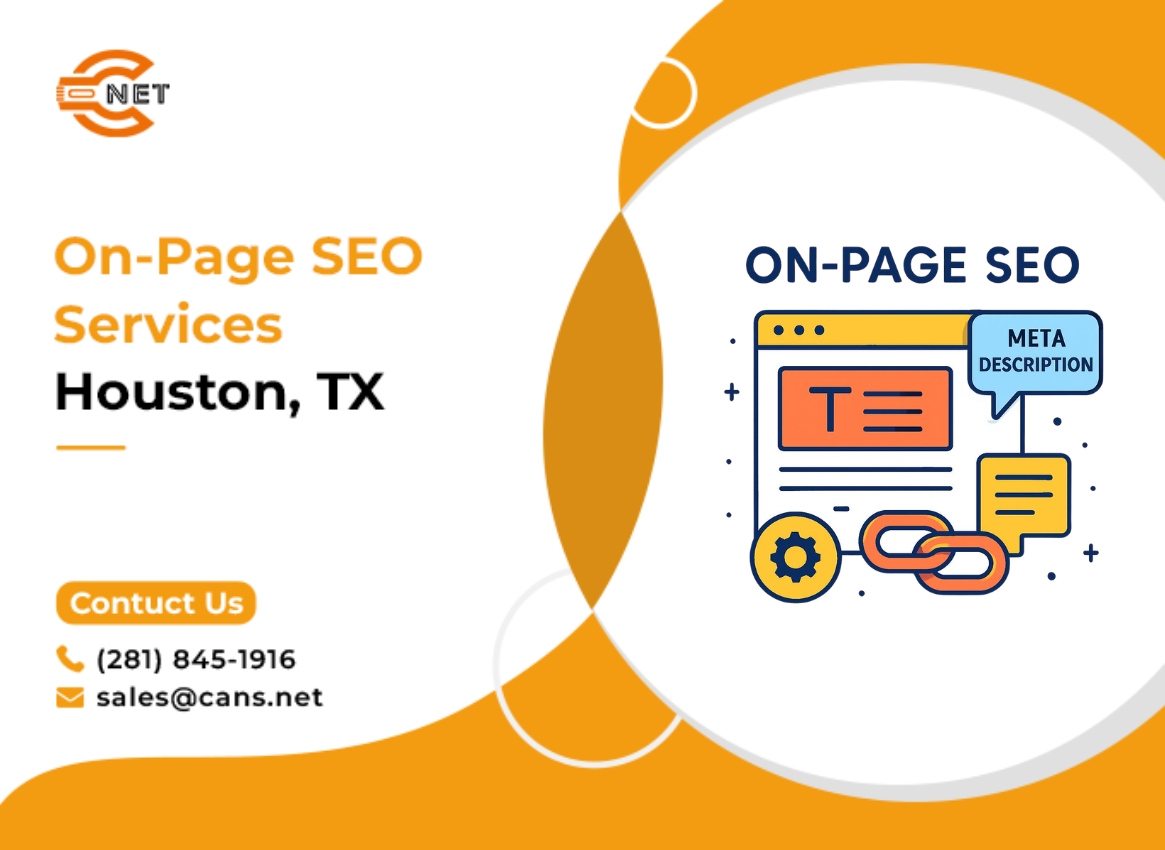
On-page SEO is the practice of optimizing individual web pages to improve search visibility and rankings. On-page elements are refining content, HTML elements, page titles, headings, meta tags, page descriptions, page URL, page structure, internal links, page summary, and user page experience. Effective on-page SEO uses semantic analysis and keyword placement to signal relevance to search engines and satisfy crawlers and human intent.
Houston businesses are struggling with slow rankings, weak local signals, duplicate content, poor mobile UX, incorrect keyword placement, or missing entity recognition/TF-IDF relevance—what on-page fixes will move your pages up? That’s the goal of on-page SEO- to show at the top of the search results.
As a digital marketing agency based on Houston, We understand the challenges and opportunities local businesses face in improving their web page visibility in search results.
Whether you’re an experienced marketer or just starting, this guide to on-page SEO will help you enhance your online presence and attract more customers in Houston. Most importantly clarifies what is on page seo with actionable strategies to optimize your web page effectively.
What is On-Page SEO?
On-page SEO refers to techniques used directly on a website page to improve search engine ranking. It focus on optimizing page elements to make it easier for search engines to understand the page’s purpose and relevance to specific searches. Therefore, on-site SEO is vital factor for local search engine optimization.
Why On page SEO is Important?
Optimizing your site communicates that the page is a valuable resource for users searching for related information.
This helps search engines understand the context and relevance of your content. As a leading SEO company in Houston, TX, this is the core principle.
Key on-page SEO factors include:
- Title Tag: The NLP(natural language processing) term added title tag is a critical on-page SEO element that informs search engines about the topic of the page. Title tag, meta tags, comprising a clear heading or exciting terms like offer, discount turns to maximum click. Try to keep different H1 and Title.
- Meta Description: A well-optimized meta description improves click-through rates from search results.
- URL Slug: Meaningful page or product link within 75 characters(keyword included) boosts ranking
- Content of the Page: High-quality, relevant content is essential for good on-page SEO.
- Keyword Optimization: Focus on high-intent keywords with strong informational and commercial search volume.
- Internal Links: Linking to other pages on your website enhances user experience and distribute page authority. Moreover, a good structured links between pages or post enhances to index on search engine like google, bing or AI chatbot faster.
- Page Load Speed: A fast-loading page is a ranking factor that affects user experience.
- Alt Text: Utilizing alt text for images improves accessibility and helps search engines understand the content.
- External Link: A do follow link or no follow attribute
- FAQ: Including the most relevant questions with clear, concise answers helps satisfy users’ additional queries about your service or product.
Note: Implementing On Page SEO best practices ensures long-term ranking success.
On-Page vs Off-Page SEO
To truly grasp the essence of on-page SEO, it’s important to differentiate it from off-page SEO. While on-page SEO involves optimizing elements within your website, off-page SEO focuses on activities conducted outside of your site to improve its ranking.
We typically handle on-page optimization by refining page content, optimizing title tags, and ensuring a seamless user experience.
Off-page SEO, on the other hand, involves building backlinks from other reputable websites, engaging in social media marketing, and managing your online reputation.
Other Off-page SEO strategies include directory submissions, PDF submissions, citations, profile backlinks, guest posts, HARO link building, image submissions, and forum submissions. All backlinks are listed based on Houston-related websites and relevant topics that audiences are connecting to near Houston..
On-page SEO makes your website appealing, while off-page SEO builds authority. Think of on-page and off-page SEO as two sides of the same coin; both are crucial for a successful SEO strategy.
The former makes your website appealing to search engines and users, while the latter builds authority and credibility in the online world.
This distinction is vital to understand when crafting SEO strategies that deliver results. This will help search engines rank higher with time.
SEO Factors that Influence Your Rankings for Houston
Key SEO factors influencing rankings include content quality, keyword usage, title tag/meta description optimization, heading structure, and internal linking. Several key SEO factors significantly influence your rankings in search results.
These on-page SEO factors include the quality and relevance of your page content, the strategic use of target keywords throughout the page, the optimization of title tags and meta descriptions, the structure of your headings, and the presence of internal links to other relevant pages on your website.
In addition, technical SEO aspects such as page speed, mobile-friendliness, and website architecture play a crucial role. I pay close attention to optimizing alt text for images, as this not only improves accessibility but also provides search engines with valuable context.
By addressing these ranking factors comprehensively, We ensure that your website is well-positioned to achieve higher visibility in search engine results pages (SERPs). I always use SEO tools for a page SEO checker.
Some important SEO ranking factors are:
| Category | Factors |
|---|---|
| On-Page SEO | Content quality, Keyword usage, Title tag/meta description optimization, Heading structure, Internal linking |
| Technical SEO | Page speed, Mobile-friendliness, Website architecture, structured schema markup |
| Off Page SEO | Brand mentions, Citations, Directory listing, Profile links, Guest post, HARO Backlink (Help A Reporters Out) |
| Local SEO | Google My Business or GBP optimization, Bing Place optimization, Local citations, directory, PR submission |
Why On-Page SEO is Crucial for Local Businesses in Houston
On-page SEO is essential for Houston businesses to appear in local search results. For local businesses in Houston, on-page SEO is not just important; it’s essential for survival in today’s competitive digital landscape.
When someone searches for a “digital marketing agency in Houston, TX” or a “SEO company in Houston, TX”, I want your business to be among the first search results they see. On-page optimization allows me to target specific local keywords and phrases that your potential customers are using to find businesses like yours.
By optimizing your page content with relevant information about Houston, such as local landmarks, neighborhoods, and community events, we signal to search engines that your business is relevant to local searchers.
Furthermore, a well-optimized website provides a better user experience, encouraging visitors to stay longer and explore your offerings. I use on-page SEO tactics to make your business visible and accessible to the Houston community.
How to Optimize Your Page for Search Engines
Now that We have covered the fundamentals, let’s dive into how to optimize your page for search engines. SEO optimization involves a series of strategic steps aimed at improving your website’s visibility and relevance.
We approach each page with a meticulous checklist to ensure that every on-page SEO element is optimized effectively. Besides, our website designer structures WordPress or custom websites so that search engines can easily decode their page architecture. You can even hire us for website design and development services for Houston, TX
The key is to create a seamless user experience while also providing search engines with clear signals about your content.
Regular on-page SEO strategy ensures that when potential customers in Houston search for services you offer, your website appears prominently in the search results.
1. Crafting the Perfect Title Tag for Your Content
A good title tag should be clear, concise, relevant, and include the target keyword. The title tag is one of the most crucial on-page SEO factors, as it appears in search engine results pages and tells both search engines and users what your page is about. When we craft title tags, we aim for clarity, conciseness, and relevance.
We always include your target keyword, ideally near the beginning, to signal the page’s primary focus. It is also important to keep the title tag under 60 characters to prevent truncation in search results.
A well-optimized title tag not only improves your search ranking but also entices users to click through to your site. I will optimize title tags with a focus on keywords that will help search engines rank higher.
2. Writing Meta Descriptions that Drive Clicks
Meta descriptions should be compelling, informative summaries with a clear call to action. While meta descriptions do not directly impact search engine rankings, they play a vital role in driving clicks from search engine results pages. The meta description provides a brief summary of your page content, giving users a glimpse of what they expect to find.
We write compelling and informative meta descriptions that accurately reflect the page’s content and include a clear call to action.
When we write meta descriptions, we’re mindful of character length limitations(160 characters) and focus on creating a message that resonates with your target audience.
The better the click through rate from the search results, the better search engines will rank your website. Optimizing your website’s meta descriptions is a crucial element of on-page SEO.
3. Website page URL:
An ideal website page URL is short, readable, and uses the right keywords. It reflects the search query so that the user and the search engine understand your page. When we use the exact right keyword in the URL, it ranks well.
4. Content of the Page
Create comprehensive, logically structured content that covers definitions, benefits, examples, and step-by-step guidance. Use headings, bullet lists, visuals, internal links, and update content regularly to keep it authoritative and aligned with user intent. Our SEO specialist follows a semantic SEO strategy to rank for AI mode, AI overview or other LLM platforms.
5. Keyword Optimization
Research user intent-driven keywords. For example, “what is on page seo”. For that use primary in title, H1, and early paragraph, include LSI/related terms, optimize meta tags, maintain natural density, and map keywords across pages to avoid cannibalization.
6. Leveraging Internal Links to Boost SEO
Internal links are crucial for optimizing your website as they improve several key aspects. They’re an often-overlooked aspect of on-page optimization, yet they significantly boost your website’s SEO.
Internal links involve linking from one page on your website to another, creating a network of interconnected content. When implemented effectively, internal links help:
- Guide users to relevant content, increase page views, and improve user experience.
- Improve page load, distribute link juice, and enhance your overall SEO.
7. Page Load Speed Optimization
- Accelerate your website by combining technical precision with user-first performance strategy. Start by optimizing images with modern formats like WebP or AVIF, enabling lazy loading, compressing assets, and reducing render-blocking JavaScript and CSS. Use HTTP/2 or HTTP/3, implement efficient browser caching, and deploy a high-performance hosting environment with a reliable CDN.
- Go further by setting clear performance budgets, leveraging resource hints such as preload and prefetch, and optimizing the critical rendering path to ensure above-the-fold content loads instantly. Continuously monitor both Core Web Vitals and real-user metrics, prioritizing improvements to Largest Contentful Paint (LCP) and Cumulative Layout Shift (CLS).
- Faster pages enhance user experience, lower bounce rates, strengthen engagement, and contribute to stronger search visibility and conversion performance.
8. Alt Text
Write descriptive, concise alt text for images that includes the primary phrase when natural (e.g., “on-page SEO checklist”). Additionally describes image content for accessibility, avoids keyword stuffing, and depicts image search relevance while matching page intent.
These on-page SEO tactics improve your website’s ability to rank higher.
9. External Link
Link to authoritative, relevant sources (studies, official docs, Wikipedia, reputed website) to support claims. Don’t give a link to direct competitors. rather inject a link to a higher authority website or organizations in your industry.
Use descriptive anchor text, nofollow/sponsored when appropriate, open links responsibly, and ensure outbound links add user value and topical relevance to boost trust and context.
10. FAQ
Include concise, user-focused questions and answers that target long-tail queries around “topic your nearby audiences in Houston ask on forums or other sites or persons”.
Use schema/FAQPage markup, cover common intents, link to deeper resources, update regularly, and optimize each Q/A for featured snippets with clear, direct answers and relevant keywords.
11. Topic Cluster
Build a pillar page for “Topic” and link to cluster pages for subtopics (meta tags, schema, content optimization). Use consistent internal linking, shared taxonomy, and Silo structure to signal topical authority and improve crawlability.
SEO Strategies for Effective Content Optimization
Choosing the Right Target Keywords
Choose keywords based on search volume, competition, relevance, and user intent. Selecting the right target keywords is the bedrock of any successful SEO strategies, particularly for on-page optimization.
We begin by conducting thorough keyword research, identifying the terms and phrases your potential customers in Houston are actively searching for. This involves using various SEO tools to analyze search volume, competition, and related keywords.
We focus on finding a balance between high-volume keywords and long-tail keywords that are specific to your niche.
When we choose target keywords, we consider the intent behind each search, ensuring that your page content aligns with what users are actually looking for.
By choosing the right target keywords, CANS ensure that your page content is relevant, visible, and effectively attracts organic traffic from search engine results pages.
Applying On-Page SEO Techniques to Enhance User Experience
On-page SEO and user experience go hand-in-hand, focusing on site speed, mobile-friendliness, and intuitive navigation. Applying on-page SEO techniques goes hand in hand with enhancing user experience.
The ultimate goal of search engines is to provide users with the best possible search results, so I strive to create a website that is not only optimized for search engines but also enjoyable and easy to use.
This involves optimizing page load speed, ensuring mobile-friendliness, and creating clear and intuitive navigation. We use high-quality images and videos to enhance the visual appeal of your page content, but we also optimize alt text to improve accessibility and SEO.
By prioritizing user experience alongside on-page optimization, we create a website that attracts and retains visitors. That leads to higher search rankings and increased conversions. This improves user experience.
Monitoring Page Load Speed as an SEO Factor
Optimize page load speed by optimizing images, leveraging browser caching, and minimizing HTTP requests. Page load speed is a critical SEO factor that directly impacts user experience and search rankings. Slow-loading web pages frustrate visitors and lead to high bounce rates, signaling to search engines that your page content is not valuable.
We use various tools(GT Metrix, google page speed insights, SEMrush) and techniques to monitor and improve page speed, including optimizing images, leveraging browser caching, and minimizing HTTP requests.
We also ensure that your website is hosted on a reliable server with sufficient bandwidth. Through optimizing your page load speed, we provide users with a seamless browsing experience.
The outcome is improved search rankings and a higher likelihood that visitors will engage with your content and convert into customers. This is a crucial element of the on-page SEO checklist.
| Package | Features (on-page seo & on-page optimization) | Benefits (how it helps search engines and users) | Price |
|---|---|---|---|
| Basic | On-page SEO audit of one web page (on-page factors, page structure) Title tag + meta description optimization for one page (page title, page description) Target keyword and keyword research (right keywords, keyword optimization) Basic on-page content recommendations (content of the page, incorporate keywords) Internal linking suggestions to a linked page (internal linking) Page URL and page summary checks (page url, page summary) On-page SEO checklist delivered (on-page seo checklist, seo best practices) | Helps search engine understand the page and index it properly (help search engine, search engine result) Improves relevance for target keyword and search intent Better user experience through optimized title tag and meta description (better user experience, user experience) Local lift in search engine rankings and potential to rank higher for single page queries Foundation for future on-page and off-page SEO efforts | $199 |
| Standard | Everything in Basic plus multi-page on-page optimization for up to 5 website pages (website pages, every page) Advanced keyword research and keyword mapping by page (keyword research, target keyword) Optimized title tags, meta descriptions, and page content (page title, meta, meta description, content on the page) Technical SEO checks: page load, page speed, basic page experience fixes (technical seo, page load, page speed, page experience) Internal linking and on-page linking structure implementation (internal linking, linked page) On-page seo strategy document with SEO best practices and on-page factors to follow (on-page seo strategy, seo best) Report on expected impact on organic traffic and search engine results pages | Stronger on-page optimization across multiple pages improves search engine rankings and organic traffic Addresses ranking factor issues and technical blockers that prevent pages from ranking (ranking factor, technical seo) Aligns page content with search intent to increase clicks from search engine results pages Provides a repeatable on-page SEO process to scale SEO success (seo strategies, seo practices) | $599 |
| Advanced | Full on-page and on-page + off-page coordinated plan for up to 15 pages (on-page and off-page seo, on-page seo vs off-page) Comprehensive keyword research, content gap analysis, and content optimization (keyword research, content of the page, content on the page) Full technical SEO audit and fixes: page speed optimization, structured data, mobile and page experience improvements (technical seo, page speed, page experience) Optimized title tags, meta descriptions, canonicalization, page url strategy, and on-page elements (title tag, meta, page url, on-page elements) Internal linking architecture and siloing to help search engines and users navigate (internal linking, page structure) On-page content creation and editing for SEO best results (on-page content, incorporate keywords, keyword optimization) Ongoing monitoring, A/B testing of meta and content, and measure on-page SEO success (measure on-page seo success, seo is an ongoing process) | Maximizes ability to rank higher for target keyword sets and broader search engine result opportunities Improves organic traffic sustainably by combining content, technical, and on-page factors Better user experience and search intent matching across website pages leading to higher engagement Delivers a full SEO strategy that supports off-page SEO outreach and long-term SEO success (seo strategies, seo success, on-page and off-page seo) | $1,499 |
Checklist for On-Page SEO for Houston Business Success
Essential On-Page SEO Factors to Review
Before diving into implementation, conduct a thorough review of several essential on-page SEO factors. This on-page SEO checklist ensures that every page on your site is primed for optimal performance in search results whether you’re a professional or business owner.
Start by assessing the strategic use of target keywords throughout the page content. The best way is paying close attention to local search intent, keyword density and placement of NLP terms.
The next step is examine the optimized title tags and meta descriptions, ensuring they accurately reflect the page’s focus and entice clicks from search engines and users.
The third step is evaluate the structure of your headings, the presence of internal links, and the overall readability of your page content.
After systematically reviewing these SEO factors, identification areas for improvement becomes easier.
That’s how we develop a tailored on-page optimization plan that maximizes your website’s visibility and user experience.
Technical SEO will also need to be addressed with a tool for page SEO checker.
SEO Tactics to Implement for Better Rankings
Once we identify areas for improvement, we implement a range of SEO tactics to enhance your page’s ranking potential. This includes refining page content to be more relevant, informative, and engaging for your target audience.
We optimize alt text for images to improve accessibility and provide search engines with valuable context about your visuals. I strategically incorporate internal links to guide users to related content and distribute link juice throughout your website.
We also focus on improving page speed, ensuring that your pages load quickly and provide a seamless user experience. By implementing these SEO strategies, the best SEO service provider in Houston, Texas and near by areas create a website that is not only optimized for search engines but also enjoyable and valuable for your visitors. These on-page SEO tactics will help search engines rank higher.
Evaluating Your On-Page SEO Efforts
Evaluating the effectiveness of my on-page SEO efforts is crucial for long-term success. This involves monitoring your website’s ranking in search results, tracking organic traffic, and analyzing user engagement metrics. Use various SEO tools to track keyword rankings, identify high-performing pages, and uncover opportunities for further optimization.
Pay close attention to bounce rates, time on page, and conversion rates to assess the effectiveness of your page content and user experience.
By continuously evaluating your on-page SEO efforts, refine strategies, adapt to changing search engine algorithms, and ensure that your website remains competitive in the ever-evolving digital landscape.
Through the SEO tools, you measure the on-page SEO factors. This review will allow search engine optimization to get better results for every page on your site.
What are Common On-Page SEO Mistakes?
Common on-page SEO mistakes hinder a website’s performance, even for experienced marketers. These include issues like keyword stuffing, neglecting title tags and meta descriptions, and poor internal linking. Addressing on-page SEO is crucial for better rankings.
| Mistake Type | Description |
|---|---|
| Keyword Stuffing | Excessively using target keywords in an unnatural way. |
| Title Tags and Meta Descriptions | Neglecting to optimize them, missing click opportunities. |
Poor internal link structures and failing to optimize images with alt text are also common on-page SEO blunders. These mistakes negatively impact user experience and ranking.
How Does Technical SEO Fit into On-Page Strategies?
Technical SEO complements on-page SEO by ensuring the website is mobile-friendly, crawlable, and free of technical errors. Technical SEO and on-page SEO are intertwined and work together to improve your website’s visibility.
While on-page SEO involves optimizing elements within your page content, technical SEO focuses on the underlying infrastructure and technical aspects of your website.
This includes ensuring that your website is mobile-friendly, has a clear and logical website architecture, and is free of technical errors that hinder search engines from crawling and indexing your pages.
Address technical SEO issues such as broken links, duplicate content, and slow page load speed to ensure that your website is fully optimized for search engines. I will use the SEO tools to test the page speed on your site.
By integrating technical SEO into your on-page SEO strategies, we create a website that is both user-friendly and search engine-friendly, maximizing your chances of ranking higher in search results.
What is the Best Way to Do On-Page SEO for Houston Local Businesses?
This involves targeting specific local keywords and phrases that your potential customers are using to find businesses like yours.
As a local SEO company in Houston, Texas- we suggest to include local information like landmarks, neighborhoods, and events in your page content to show search engines your business is relevant to local searchers.
How many seo keywords per page?
How to do on page audit?
How many internal links per page?
How to do on page seo for ecommerce product pages?
To get mentioned in Google lens use optimized images with alt text and compressed sizes, canonical tags, schema.org product markup, and breadcrumb navigation.
On top of that, fast mobile-friendly pages, user reviews, and internal linking to category pages boost relevancy and conversions.
What are the on page seo optimization tool?
What is page authority in seo?
How to seo your landing pages?
On sections, include structured data where relevant, ensure fast mobile performance, add clear CTAs, use internal links, A/B test elements. Last of all monitor conversions and search analytics to iteratively improve rankings and engagement.
what are the negative impacts of ai overviews on seo?
What is an on page SEO checker extension?
It provides real-time recommendations and actionable fixes so you can optimize content, improve rankings, and monitor on-page health without leaving your browser.
Those extensions are- Detailed SEO Extension, SEO Meta in 1 Click, SEO Quake etc.
Serious About Ranking in Houston? Let’s Fix Your On-Page SEO Now
By tailoring your on-page SEO efforts to the specific needs of local searchers of Houston, We supercharge your business attract more customers from the Houston area.
The guide to on-page SEO is not difficult but requires detailed work on every page. This will rank higher with time. Our service areas are-
Austin, Dallas, Richmond, The Woodlands, Missouri City, Sugar Land TX